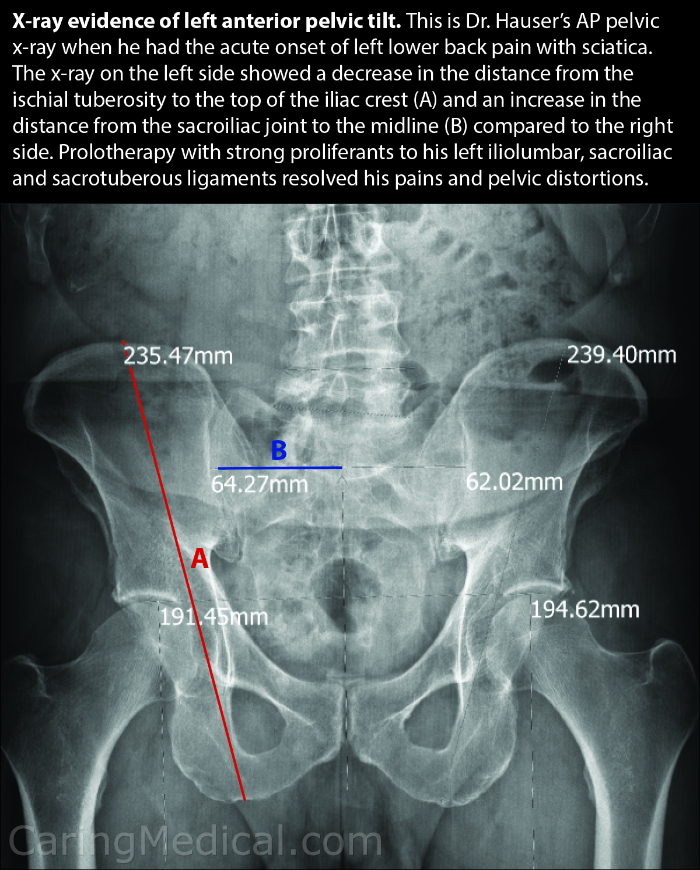
In this image, we see an x-ray of a patient. The x-ray is of Dr. Ross Hausers pelvic tilt. Dr. Hauser suffered from the sudden and acute onset of lower back pain on his left side..
He also displayed symptoms of sciatica. The x-ray revealed on his left side a decrease in the distance from the ischial tuberosity to the top of the iliac crest..
This means that there would be an increase in tilt between the left and right sides. This is displayed in the increase in distance from the sacroiliac joint to the midline compared to the right side. For Dr.
Hauser, Prolotherapy treatments to his left iliolumbar, sacroiliac, and sacrotuberous ligaments resolved his pain and pelvic distortions.
With leg-length discrepancy, either hip joint can cause pain, and usually both hip joints hurt to some degree. To propel the leg forward, the hip joint must be raised which strains the gluteus medius muscle and connective tendons and the posterior hip ligaments. Leg-length problems are also associated with recurrent lower back problems because they cause the pelvis to be asymmetric.
Whether it is a low back problem, pubis problem, pelvic floor, or hip problem, leg length discrepancy can cause significant and disabling problems down the road.
Prolotherapy is an injection treatment that stimulates the repair of connective tissues such as tendons and ligaments. It causes a mild inflammatory response which initiates an immune response. This mimics what the body does naturally to heal soft tissue injuries. The most common pelvic instability is sacroiliac instability, caused by injuries to the stabilizing ligaments of the sacroiliac joint. These ligaments are typically injured through the combined movements of spinal flexion and rotation.
Prolotherapy: Treating the ligaments in sacroiliac joint dysfunction We treat the whole low back area to include the sacroiliac or SI joint. Summary and Learning Points of Prolotherapy to the low back
Femoroacetabular Impingement may only be one part of a bigger problem
such as the problems of leg length discrepancy, pelvic tilt, pelvic incidence
lumbar lordosis mismatch, and walking difficulties